Software Engineer /
Full-Stack Engineer

Igor Kadziela— Software Engineer / Full-Stack Engineer

Profile

I build end-to-end software systems that combine robust backend architecture, modern web interfaces, data processing and AI.

Core stack

  • Java / Spring Boot
  • TypeScript / React / Next.js
  • Python / FastAPI
  • PostgreSQL / PostGIS
  • AI / RAG

Open to

Internship or Junior Full-Stack Engineer · full-time

03Projects

Work mode

Remote, hybrid or on-site · open to relocating abroad

Selected
work

Two full projects and one in development: an AI research workspace, a spatial parcel-analysis platform and a tool for building managers. Nothing is hosted: each case study pins screenshots and links to the source on GitHub.

Project 01 / 03

Active development
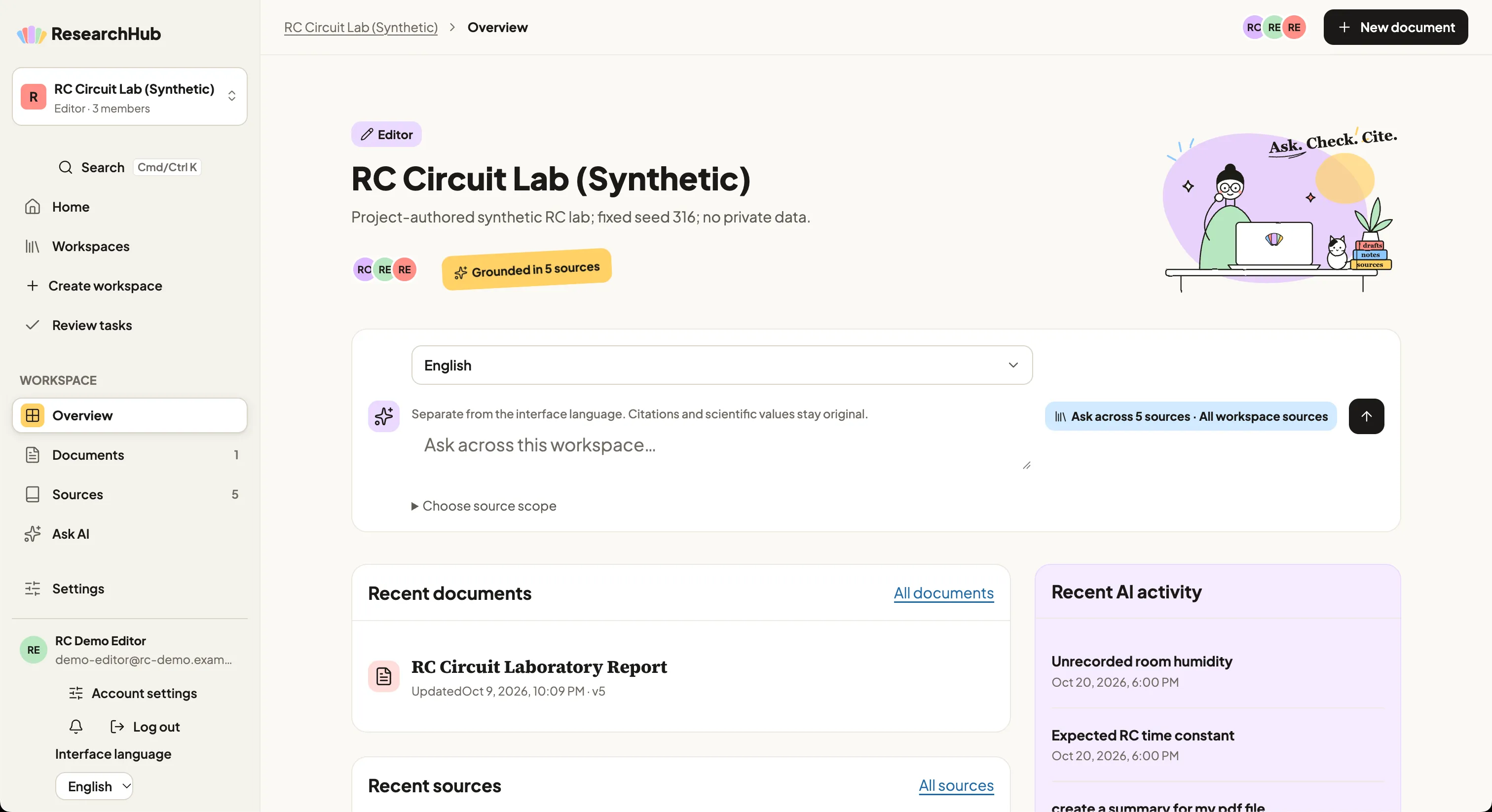
The ResearchHub workspace overview: sidebar navigation, a question box that asks across five sources, recent documents and recent AI activity.

ResearchHub

Source-grounded collaborative AI workspace for students and researchers.

Overview

A shared workspace where a group collects sources, writes a report and asks an AI that stays grounded in those sources. Charts, tables, calculations and generated claims keep provenance back to the source file, fragment, dataset or executed analysis.

Works with

PDFs · DOCX files · Spreadsheets · Datasets

Status
Active development
Runs
Locally, not deployed
My role
Sole contributor to the repository.

Engineering highlights

  1. Cited answers, or an explicit “no evidence”

    Questions are answered from the selected sources with traceable citations. When the sources do not support an answer, the result says so.

  2. Immutable source versions

    Replacing a file adds a new version. Older bytes stay downloadable and every analysis records the exact versions it used.

  3. Computation in a Docker sandbox

    Analysis code runs in a pinned, isolated Python image with filesystem, network and resource limits. Results keep their inputs and run history.

  4. Realtime editing, enforced boundaries

    Co-editing on Yjs and Hocuspocus, saved through authorized Spring persistence. Workspace authorization is enforced by the server, including internal service calls.

Technologies

Backend & AI worker

  • Java 25
  • Spring Boot 4.1
  • Maven
  • Flyway
  • Python 3.13
  • FastAPI

Frontend & realtime

  • React
  • TypeScript
  • Webpack
  • TanStack Query
  • Tiptap / ProseMirror
  • Yjs
  • Hocuspocus

Data & infrastructure

  • PostgreSQL 17
  • pgvector
  • Azure Blob Storage / Azurite
  • Docker
  • Bicep (Azure IaC)

Project 02 / 03

Spatial / GIS

Spatial / Investment Parcel Analysis Platform

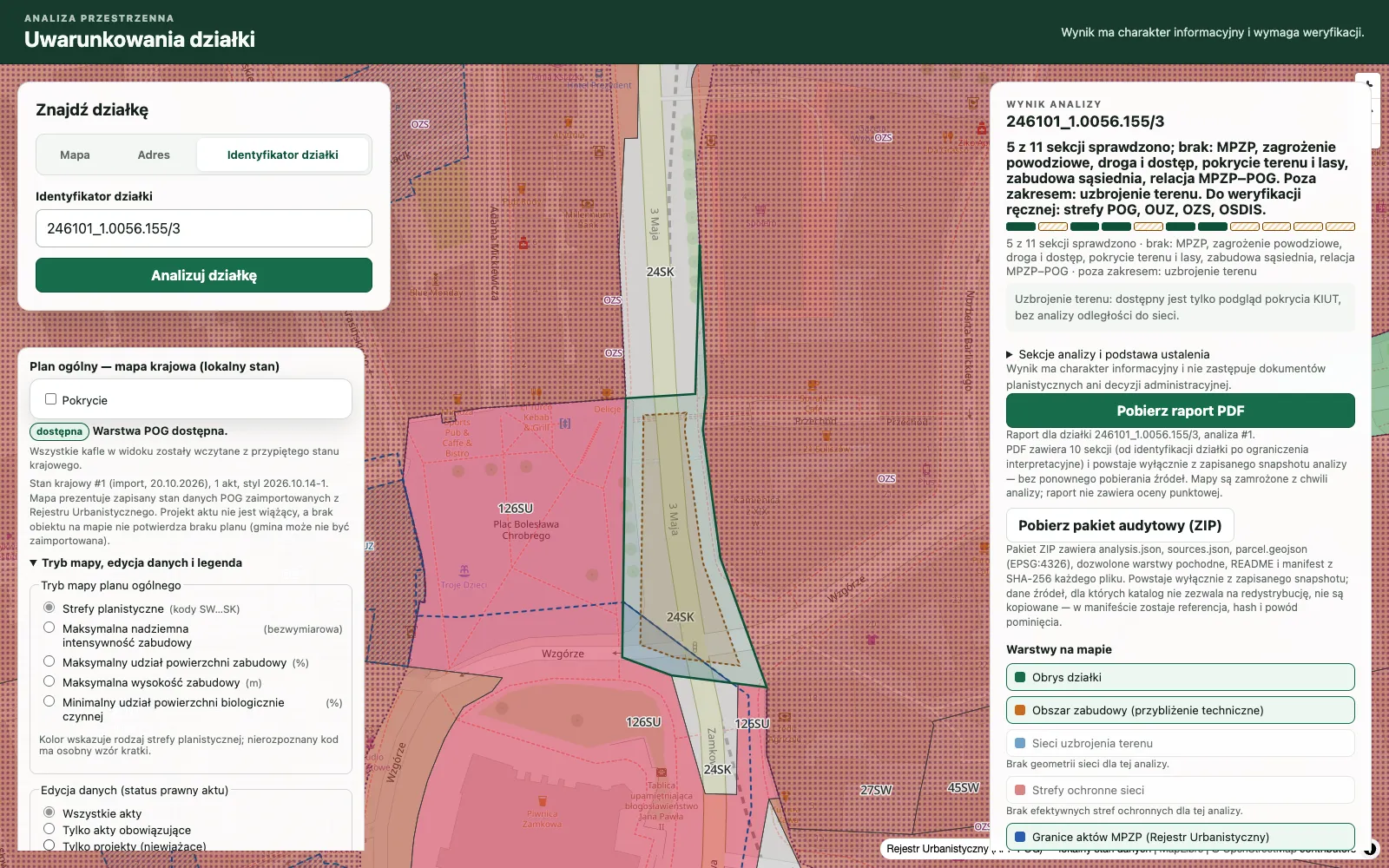
A parcel outline and general-plan zones appear beside the Polish analysis completeness panel.

Spatial / GIS

System Analizy Uwarunkowań Działki

Spatial / Investment Parcel Analysis Platform

Overview

A web application that analyses the planning and investment context of a Polish land parcel. It combines GIS data and spatial-planning datasets, shows the result on a map and produces a PDF report with a verifiable audit package.

Analysis areas

  • Local spatial plans (MPZP)
  • General plans (POG)
  • OUZ and related planning data
  • Flood-risk data
  • Protected areas
  • Terrain / elevation
  • Roads and neighbouring buildings
  • Map layers
Domain
GIS · Polish spatial-planning data
Runs
Locally, not deployed
My role
Sole contributor to the repository.

Engineering highlights

  1. Missing data is not an all-clear

    Every section has its own status, freshness and provenance. “Not checked” is never shown as “no restriction”, and the headline stays partial until everything in scope was checked.

  2. Vector tiles straight from PostGIS

    Mapbox Vector Tiles generated from PostGIS for the planning layer; WMS previews are proxied with tile caching; coordinate transformations are handled explicitly.

  3. Reproducible reports, verifiable audit package

    PDF reports built from immutable analysis snapshots, plus an audit ZIP whose SHA-256 manifest a stand-alone script verifies.

  4. MPZP extraction researchExperimental R&D

    Deterministic parsing of local-plan documents, with an optional LLM path that is off by default. Model output is only a labelled candidate for manual verification.

Technologies

Backend

  • Python
  • FastAPI
  • SQLAlchemy
  • GeoAlchemy
  • Alembic

Frontend & maps

  • Next.js 16
  • React 19
  • TypeScript
  • MapLibre

Spatial data & infrastructure

  • PostgreSQL 16
  • PostGIS 3.4
  • GIS / spatial data processing
  • Docker Compose

Project 03 / 03

In development

The obiekt.io wordmark and the tagline “Narzędzie dla zarządców budynków: od zgłoszenia do odbioru” beside a black door-shaped mark and four coloured tiles.

obiekt.io

A tool for building managers: from a report to a documented repair.

The product · in development

The product

A planned SaaS tool for building managers: residents report faults by QR code, voice or e-mail, contractors work from a link, and every job ends with a PDF protocol and acceptance. Only the foundation exists so far.

Planned flow

  • Report by QR, voice or e-mail
  • Send to a contractor
  • Work from a link, no account
  • Protocol and acceptance
Status
In development
Stage
Foundation done · product next
My role
Sole contributor to the repository.
Source
Private repository

What is coming

  1. Three ways in, one case

    A QR form, a voice assistant and e-mail all open the same ticket. The reporter gets a case number only after it is saved.

  2. Contractors without accounts

    A work order is a link. Entry codes appear only after an SMS check on the contractor’s phone and stop working when the job is accepted.

  3. AI proposes, people decide

    AI sorts and translates reports in Polish, English and Ukrainian. Danger alerts never wait for it, and acceptance stays with the manager.

  4. A record of every repair

    A short completion form becomes a versioned PDF protocol. Costs stay outside the app; the manager gets a summary of work done.

Technologies

Application skeletons (built)

  • Next.js 16
  • React 19
  • TypeScript
  • Java 25
  • Spring Boot 4.1
  • Spring Modulith
  • Python
  • FastAPI

Platform (planned)

  • PostgreSQL + pgvector
  • Row-level security
  • S3-compatible storage
  • Keycloak (OIDC)
  • OpenAPI contracts
  • Docker Compose

Integrations (planned)

  • ElevenLabs voice agents
  • E-mail in and out
  • SMS
  • LLM provider (to be chosen)
  • PDF generation

Engineering
stack

Technologies grouped by their role in a system. Squares mark which of the three projects use each one.

  • 01 ResearchHub
  • 02 Parcel analysis
  • 03 obiekt.io

Backend

  • Java (used in ResearchHub)
  • Spring Boot (used in ResearchHub, obiekt.io)
  • Python (used in all three projects)
  • FastAPI (used in all three projects)
  • REST APIs

Frontend

  • TypeScript (used in ResearchHub, Parcel analysis)
  • React (used in ResearchHub, Parcel analysis)
  • Next.js (used in Parcel analysis, obiekt.io)

Data

  • PostgreSQL (used in ResearchHub, Parcel analysis)
  • PostGIS (used in Parcel analysis)
  • pgvector (used in ResearchHub)
  • SQLAlchemy (used in Parcel analysis)

AI / data systems

  • RAG (used in ResearchHub)
  • Embeddings (used in ResearchHub)
  • Provenance (used in ResearchHub, Parcel analysis)
  • Source-grounded generation (used in ResearchHub)
  • Structured AI workflows (used in ResearchHub)

IoT

  • Raspberry Pi
  • IoT system architecture
  • Kiosk devices

Engineering

  • Docker (used in ResearchHub, Parcel analysis)
  • Git / GitHub
  • CI
  • Testing (used in ResearchHub, Parcel analysis)
  • Architecture documentation

About

My work sits where backend architecture, data and the interface have to agree. ResearchHub ties AI answers to the sources they came from. The parcel-analysis platform separates missing data from a confirmed absence of a restriction. obiekt.io, still in its foundation stage, is a tool for building managers.

What I work on

  • Full-stack systems
    From database schema to interface, inside one product.
  • Backend architecture
    Clear boundaries between services, workers and domains.
  • Data-heavy applications
    PostgreSQL, PostGIS and spatial processing.
  • AI grounded in real data
    RAG with citations back to source chunks.
  • Reproducibility and provenance
    Immutable snapshots, hashed audit exports.
  • Databases
    PostgreSQL, pgvector, PostGIS, SQLAlchemy.
  • Developer quality practices
    Automated tests, coverage gates, architecture documentation.

Profile details

Education
Computer Science, University of Bielsko-Biała · since 10.2023, final semester
Now
IT Intern, IT department · Iturri Poland
11.2025 – 06.2026
Frontend Developer · Kaks s.c. and MKA Sp. z o.o.
Target role
Junior Full-Stack Engineer, or an internship
Work mode
Remote, hybrid or on-site · open to relocating abroad

PDF · HTML

Resume

The same facts as this site, as a downloadable PDF and as a plain HTML page for quick reading and parsing.

Contact

Open to

Internship or Junior Full-Stack Engineer · full-time

Remote, hybrid or on-site · open to relocating abroad